The Unforgettable Flavour of Kobe Beef
What certified Kobe actually is, why the Tajima-gyu bloodline matters, and how to tell the genuine designation from the marketing term that borrowed its name.
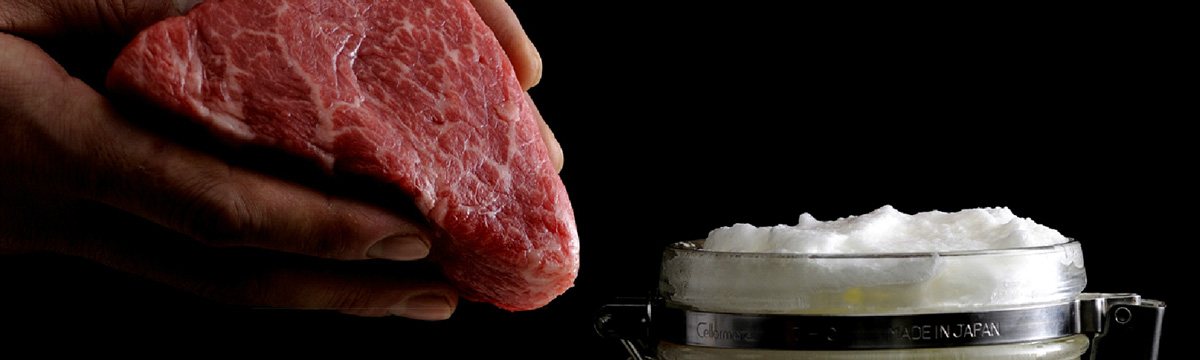
Kobe beef is a harmony of two things that rarely coexist: delicate, dignified, faintly sweet lean meat, and fat with a taste and fragrance of its own that dissolves rather than coats. The secret behind it is the marbling pattern Japanese butchers call shimofuri — literally “fallen frost” — in which the fat threads through the muscle in a fine lattice instead of sitting in seams. Because that intramuscular fat is rich in oleic and inosinic acids, it starts to soften at low temperatures. On the palate it does not melt as a figure of speech. It melts.
That single physical property drives almost every decision a kitchen makes around the beef: how it is cut, how briefly it meets heat, how small the portion is, and what is served alongside it.
On this page
What the designation covers
“Kobe beef” is not a style, a grade or a breed. It is a certification mark administered from Hyogo Prefecture by the Kobe Beef Marketing & Distribution Promotion Association, and it applies to individual carcasses that satisfy every clause of a written standard. A restaurant cannot decide its beef is Kobe. The association decides, animal by animal, and issues documentation accordingly.
The core requirements are cumulative:
- The animal is a purebred Tajima-gyu bullock or virgin cow.
- It is born, raised and slaughtered within Hyogo Prefecture.
- It is processed at an approved facility inside the prefecture.
- The carcass meets minimum thresholds for marbling, meat quality, colour and firmness.
- Gross carcass weight falls below a defined ceiling.
- The carcass receives an individual identification number and the association's seal.
Fail any one clause and the beef is simply Wagyu — possibly superb Wagyu, but not Kobe.
Why only Tajima-gyu cattle qualify
Lineage, above all else, defines and influences the texture of beef. Only pure-blood Tajima-gyu cattle are capable of producing the particular quality the Kobe standard is written around. Tajima-gyu is regarded as the pinnacle of the Japanese Black domestic breeds of Wagyu, and only a small number of animals now exist within the strictly maintained line.
Tajima-gyu animals have a thin, resilient skin, hair soft as down, and firm, tight muscles. Apart from the flavour of the meat itself, a defining feature of the breed is thin bone structure and little subcutaneous fat, which means a high percentage of the carcass is edible. Generations of docile, well-shaped, good-natured cattle have come from this lineage, and they are now bred and reared not only in the Tajima region but throughout Hyogo Prefecture.
Climate, water and the Tajima region
Tajima-gyu cattle originally came from Tajima, a mountainous region with few open fields on the northern side of Hyogo Prefecture, facing the Sea of Japan. The roots go back a long way: descriptions of Tajima cattle appear in the Shoku Nihongi, the continued chronicles of Japan, written at the beginning of the Heian period around the late eighth century.
The breed is of small build with a tight, firm body. In earlier centuries this was valued for entirely practical reasons — the animals could turn sharply in narrow terraced fields and carry heavy loads on difficult ground. The qualities unique to the strain are credited by Hyogo producers to the soft meadows and mineral-rich water of Tajima, a region characterised by large differences between daytime and nighttime temperatures and by heavy exposure to night dew.
Seedstock, tsuru lines and pure lineage
Tajima-gyu cattle are genetically strong and consistent, which is why they serve as motoushi — purebred seedstock — in Wagyu breeding programmes nationwide. Within the strain, cattle showing particularly consistent characteristics are called tsuru, and animals born from those lines are tsuru-ushi. Three substrains remain in active use, and the dominant features of each have been inherited through successive generations.
Because Tajima-gyu cattle are treasured as foundation stock, their genes have been inherited by branded beef programmes across the various regions of Japan. Yet mating and crossbreeding between Hyogo-produced Tajima-gyu and other Wagyu breeds from other prefectures is avoided even now, specifically to protect and maintain a completely pure bloodline. The cattle are supported by the care and pride of farmers working to uphold two linked heritages — Tajima-gyu and Kobe beef — with the expectation that these standards will be handed down from generation to generation.
How carcasses are graded
Japanese beef grading combines a yield grade with a meat quality grade, and Kobe certification sits near the top of both.
| Measure | Scale | Kobe requirement |
|---|---|---|
| Yield grade | A, B, C | A or B — the proportion of usable meat must be high |
| Beef Marbling Standard (BMS) | 1 to 12 | Upper end of the scale; low scores are excluded outright |
| Meat colour & brightness | 1 to 5 | Must meet a minimum threshold |
| Firmness & texture | 1 to 5 | Must meet a minimum threshold |
| Fat colour, lustre & quality | 1 to 5 | Must meet a minimum threshold |
| Carcass weight | Kilograms | Capped — oversized carcasses are ineligible |
The weight ceiling is the clause that surprises people most. In a market where bigger animals usually mean better economics, the Kobe standard deliberately caps size, on the reasoning that the qualities it is protecting do not survive scaling up.
Kobe versus “Kobe-style”
For years, the gap between the certified designation and its American usage was wide enough to support a small genre of investigative food journalism. Publications from Forbes to Eater ran pieces on how rarely the word meant what diners assumed, and the arrival of genuinely certified beef in New York was itself treated as news.
A quick taxonomy is useful:
| Term | What it usually means |
|---|---|
| Kobe beef | Certified purebred Tajima-gyu from Hyogo Prefecture, with an individual ID number |
| Wagyu | Any of four Japanese cattle breeds — or, loosely, their descendants anywhere in the world |
| Japanese A5 Wagyu | Top-graded Japanese beef, which may come from any prefecture and any qualifying breed |
| Australian Wagyu | Wagyu-genetics cattle raised in Australia, often crossbred, graded on a separate marbling scale |
| American Wagyu | Usually a Wagyu × Angus cross raised in the United States |
| “Kobe-style” | A marketing phrase with no defined meaning; frequently ordinary beef |
None of the middle categories are inferior in any absolute sense — a good Australian Wagyu porterhouse is a magnificent piece of meat, and for a large shared steak it is arguably the better choice. The point is only that they are different products, and the price gap between them is large enough that the distinction is worth knowing before ordering.
How it is cut, cooked and served
Portion size
Certified Kobe is generally sold by the ounce, with three ounces a standard minimum. This is not stinginess. The fat content makes a conventional twelve-ounce steak physically difficult to finish and, past a certain point, monotonous. Three ounces of ribeye, striploin and tenderloin served together tells you far more than twelve ounces of any one of them.
Heat
Because the fat softens early, aggressive charring works against the beef — the render outpaces the crust. Short contact with a very hot surface, a brief rest, and minimal seasoning is the standard approach. Salt, sometimes a little wasabi or ponzu, and nothing that competes.
What goes alongside
Acidity and bitterness are the useful counterweights: a sharp salad, pickles, a vinegar-dressed vegetable. Heavy cream sauces and rich sides fight the beef rather than framing it, which is why kitchens serving Kobe tend to keep the plate almost bare and put the richness elsewhere on the menu.
The New York story
The return of certified Kobe beef to New York after a long absence was covered widely at the time, and it is the reason a Midtown East steakhouse ended up in Forbes, on national television, and in a run of food-media video segments about beef authentication. The restaurant's membership of the Hyogo association made it, for a period, the only place on the East Coast where a diner could order Kobe and be shown the certificate for the animal it came from.
That is the substance behind the claim. Not a superlative about quality, which is subjective, but a verifiable administrative fact about supply chain and paperwork — which, in the case of Kobe beef, turns out to be the whole ballgame.
See how the beef appeared on the menu Read the full authenticity guide