Wagyu Grading Explained: A5, BMS and What the Numbers Actually Mean
A5 is two separate scores stuck together, and the number most people care about isn't either of them. Here is how the scales actually work.
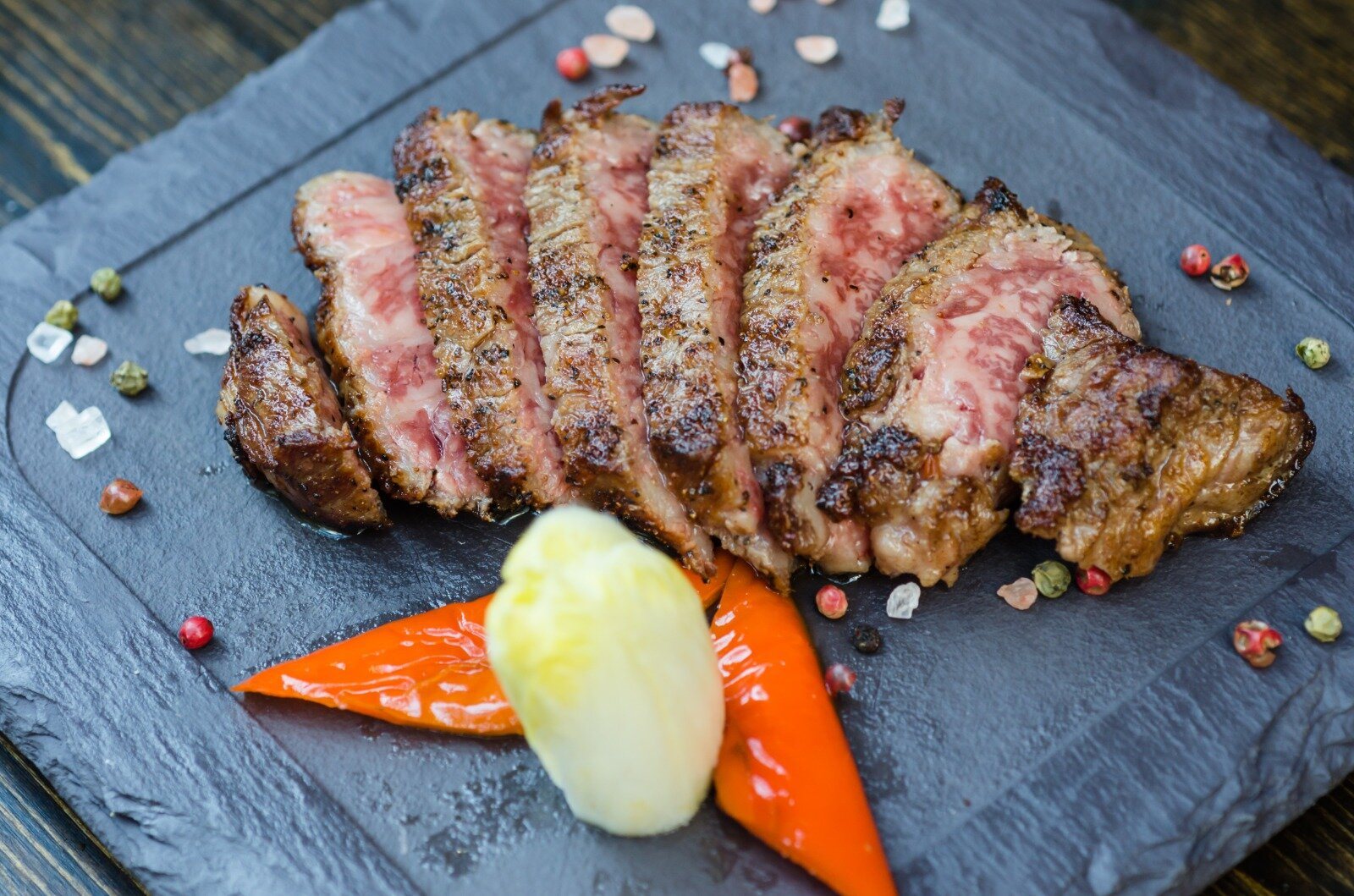
“A5” has become shorthand for expensive beef in the way that “Kobe” did a decade earlier, and it is heading in the same direction: widely used, rarely explained, and increasingly detached from what it measures. The good news is that the Japanese grading system is genuinely logical once you see its structure. It takes about five minutes to learn and it will change how you read a menu.
A5 is two grades, not one
The letter and the number measure completely different things, awarded by different assessments.
The letter: yield grade
A, B or C. This describes how much usable meat comes off the carcass relative to its weight. Grade A is above the standard yield, B is standard, C is below. It tells you about the efficiency of the animal, not the eating quality of the steak in front of you.
The number: quality grade
1 to 5, where 5 is highest. This is the one that matters at the table. It is not a single measurement either — it is the lowest of four separate scores:
- Marbling
- Meat colour and brightness
- Firmness and texture
- Fat colour, lustre and quality
Because the overall grade takes the worst of the four, a carcass with extraordinary marbling but merely good fat colour lands at the lower grade. This is why the system is stricter than it first appears.
The scale hiding underneath: BMS
Quality grade 5 covers a very wide range, and this is the source of most confusion in the retail market. Underneath it sits the Beef Marbling Standard, running from 1 to 12.
| BMS | Quality grade | In practice |
|---|---|---|
| 1 | 1 | Almost no intramuscular fat |
| 2 | 2 | Light marbling |
| 3–4 | 3 | Moderate; comparable to good US Choice |
| 5–7 | 4 | Heavy; above US Prime |
| 8–12 | 5 | Very heavy to extreme |
The practical consequence is significant: BMS 8 and BMS 12 are both “A5”, and they are not remotely the same product. A serious supplier will quote the BMS. If a menu says A5 and nothing else, the BMS is probably at the bottom of that band — which is still superb beef, but you are entitled to know.
How this compares to American grading
USDA grading uses a different logic, based principally on marbling and the maturity of the animal.
| USDA grade | Share of graded US beef | Rough Japanese equivalent |
|---|---|---|
| Prime | Small minority | Around BMS 4–5 |
| Choice | Majority | Around BMS 3 |
| Select | Substantial | BMS 1–2 |
USDA Prime, the top domestic grade, corresponds roughly to the lower-middle of the Japanese scale. That is not a criticism of American beef — the two systems are grading for different eating experiences, and a Prime dry-aged strip is doing something a BMS 11 ribeye cannot do. But it explains the price relationship, and it explains why a steakhouse serving both will portion them very differently.
Australian Wagyu and the AUS-MEAT scale
Australia runs its own marbling scale, typically cited from 1 to 9 or, in the extended version, to 12. Australian Wagyu is frequently crossbred rather than fullblood, and the resulting beef has a firmer texture and a longer, beefier finish than Japanese fullblood.
This makes it, for many purposes, the more practical choice. A thirty-two ounce bone-in ribeye of Australian Wagyu is a magnificent shared steak. The same cut in Japanese A5 would defeat most tables well before the halfway point.
American Wagyu
Usually a Wagyu × Angus cross, and generally graded on the USDA scale, where it typically lands in Prime or above. Some producers cite their own marbling scores. It sits, sensibly enough, between conventional Prime and imported Wagyu in both character and price.
Where Kobe sits in all of this
Kobe certification is not a grade — it is a designation that uses the grades as part of its criteria. A carcass must hit specified thresholds on yield and marbling, and satisfy breed and geography requirements that no grade measures at all. Every certified Kobe carcass is high-graded Japanese beef; the overwhelming majority of high-graded Japanese beef is not Kobe.
What to actually ask
- “What is the BMS?” The single most informative question about any Japanese beef.
- “Fullblood or crossbred?” Determines texture as much as marbling does.
- “Which prefecture, or which country?” Establishes what you are actually buying.
- “How many ounces?” At BMS 10 and above, portion size matters more than any other variable.
A note on chasing the number
Higher is not automatically better, and past roughly BMS 10 the beef becomes genuinely difficult to eat in quantity. The fat renders on the palate almost immediately and the effect, past a few bites, is closer to eating a rich confection than a steak.
Many people who work with Japanese beef professionally will tell you their preferred eating grade sits several points below the top of the scale, where there is still enough muscle character to taste beef alongside the fat. If you are choosing between a small portion at the very top of the scale and a larger portion slightly below it, the second is often the better dinner.
About this site. 212steakhousenyc.com is an independent editorial publication. It is not affiliated with any restaurant, supplier or certification body mentioned here, and it takes no bookings or enquiries. Details about any venue should be verified directly before you act on them. See our editorial policy.
More from the blog
Authentic Kobe Beef vs “Kobe-Style”: How to Tell the Difference
Six requirements separate certified Kobe from the marketing term that borrowed its name. Here is what each one means and how to check.
Read more →
A Steakhouse Cuts Guide: Ribeye, Strip, Filet, Porterhouse and the Rest
Where each cut sits on the animal explains everything about how it eats. A practical guide to the whole menu.
Read more →
Dry-Aged vs Wet-Aged Beef: What Actually Changes
Two processes, two completely different results. What the weeks in a locker actually do to the meat.
Read more →